| |

| OutlookAttachView v3.55 - View / Extract / Save Outlook Attachments from command-line or GUI
Copyright (c) 2009 - 2025 Nir Sofer
|
See Also
Description
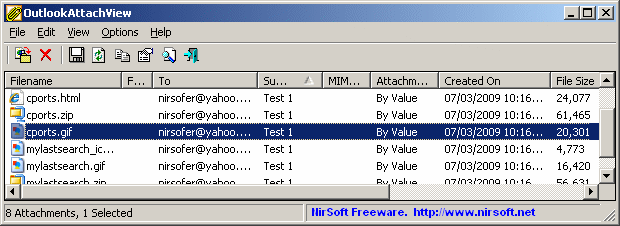
OutlookAttachView scans all messages stored in your Outlook, and displays the list of all attached files that it finds.
You can easily select one or more attachments and save all of them into the desired folder, as well as you can delete unwanted large attachments that
take too much disk space in your mailbox.
You can also save the list of attachments into xml/html/text/csv file.
System Requirements
- Windows 2000/XP/Vista/7/8/2003/2008/10/11.
- Microsoft Outlook - Any version from Outlook 2003 to Outlook 2024.
For the 64-bit version of Outlook, you should use the x64 version of OutlookAttachView.
Be aware that OutlookAttachView doesn't work with Outlook Express.
Download links are on the bottom of this page
Versions History
- Version 3.55
- Updated to display the correct profile name in the 'Mailbox Scan Options' window if it contains non-ASCII characters.
- Version 3.54
- Added 'Black Background' option (Under the View menu). When it's turned on, the main table is displayed in black background and white text, instead of default system colors.
- Version 3.53
- Fixed issue: When copying data to the clipboard or exporting to tab-delimited file, every line contained an empty field in the end of the line.
- Version 3.52
- Added 'Align Numeric Columns To Right' option.
- Version 3.51
- When you try to use the 'Delete Selected Attachments' and 'Clear Selected Attachments' options, OutlookAttachView now displays a warning
about using these options, and the default answer for the question is no.
- Version 3.50
- Scan only messages with the following 'From' strings - You can now also specify email addresses (In previous versions, the filter worked only with the sender name).
- Scan only messages with the following 'To' strings - You can now also specify email addresses.
- Version 3.48
- Added 'Sort By' button to the toolbar.
- Version 3.47
- Updated to stop the Outlook mailbox scan when you press the Esc key.
- Version 3.46
- The status bar now displays the current scanned Outlook folder.
- Version 3.45
- Added /Columns command-line option, which allows you to set the columns to display or the columns to export from command-line, for example:
OutlookAttachView.exe /Columns "Filename,From,To,Subject,Folder Name,Attachment ID"
- Version 3.44
- Fixed issue: When choosing to scan the attachments of another Outlook profile (Instead of default) while Outlook is opened in the background, the profile opened in Outlook was used, instead of the profile selected in OutlookAttachView.
- Version 3.43
- Updated to work properly in high DPI mode.
- Added option to change the sorting column from the menu (View -> Sort By). Like the column header click sorting, if you click again the same sorting menu item, it'll switch between ascending and descending order. Also, if you hold down the shift key while choosing the sort menu item, you'll get a secondary sorting.
- Version 3.42
- Added 'Copy Clicked Cell' option to the right-click context menu, which copies to the clipboard the text of cell that you right-clicked with the mouse.
- Version 3.41
- Added 'Preview Copy' option (Ctrl+M), which allows you to easily copy the text or image displayed in the preview pane into the clipboard.
- Fixed the /cfg command-line option to load the .cfg file from the current directory if full path is not specified.
- Version 3.40
- Changed to 'Image Preview' option to 'Preview Pane'. The 'Preview Pane' option allows you to view images and also the content of text-based attachments, like html.
- Version 3.35
- Added 'Enter Key Action' option, which allows you to choose what to do when you press the Enter key: Open Properties Window, Open Outlook Message, Open Attachment File, Open Selected Attachment With..., Copy Selected Attachment To...
- Version 3.30
- Added 'Scan only unread messages' option.
- Added /extractallsetreadflag command-line option to extract attachments and then set the read flag.
- Version 3.26
- Fixed bug: When closing the main window during attachment scan, OutlookAttachView remained in memory.
- Version 3.25
- Added option to search attached documents that contain the specified text.
- This feature uses the search handlers of Windows operating system to search inside Office documents and other type of files, depending on search filters installed on your system.
- You can also search attached .pdf files as long as the PDF search handler of Microsoft (Windows.Data.pdf.dll) or PDF iFilter of Adobe is installed properly on your system.
- Version 3.20
- Added option to generate MD5/SHA1/SHA256/SHA512 hashes of attachments. In order to use this feature, select the attachments you want to hash,
go to File -> Hash Selected Files -> [Hash Type] and the hashes will appear in the 'Hash' column
- Version 3.16
- You can now select the desired folder to scan or to skip from a combo-box ('Mailbox Scan Options' window).
- Version 3.15
- The last size/position of the properties window is now saved in the .cfg file.
- Version 3.13
- Added more information to the log file to diagnose a problem with deleting attachments while using the /extractdeleteall command.
- Added 'TryAgainOnDeleteFail' entry to the .cfg file. If you set it to 1, OutlookAttachView will try to delete attachment again if the first delete fails.
- Version 3.12
- Added %folder_full_path% variable to the attachment filename format.
You can use it to generate subfolders identical to the folders structure in Outlook (e.g: Personal Folders\Inbox )
- Version 3.11
- Added 'Select All' and 'Deselect All' to the 'Column Settings' window.
- Version 3.10
- Added /extractdeleteall command-line option, which extracts the attachments and then deletes them from Outlook.
- Version 3.05
- Added 'Quick Filter' feature (View -> Use Quick Filter or Ctrl+Q). When it's turned on, you can type a string in the text-box added under the toolbar and OutlookAttachView will instantly filter the attachments table, showing only lines that contain the string you typed.
- Version 3.02
- The properties window is now resizable.
- Version 3.01
- Fixed bug: 'Copy Selected Items' worked improperly when setting the 'Unicode/Ascii Save Mode' to 'Always UTF-8'.
- Version 3.00
- Added 'Message Delivery Time' column.
- Version 2.98
- Fixed bug: When pressing Delete key inside the text-box of the Find window, OutlookAttachView asked you if you want to delete the selected item instead of deleting a character inside the find text-box.
- Version 2.97
- Fixed bug: OutlookAttachView crashed when using /SaveDirect command-line option.
- Version 2.96
- Made another change that hopefully will fix a crash problem occurs on some systems.
- Version 2.95
- Fixed bug: OutlookAttachView crashed when using the find option while the last item was selected.
- Version 2.94
- Made a small change that hopefully will fix a crash problem occurs on some systems.
- Version 2.93
- You can now change the text/background colors for marking inline attachment in the .cfg file (InlineAttachmentBackColor and InlineAttachmentTextColor values).
These colors are stored in the .cfg file as Hexadecimal RGB numbers.
- Version 2.92
- Fixed bug: OutlookAttachView saved the files with incorrect encoding and Byte order mark when using /SaveDirect command-line option.
- Version 2.91
- Fixed OutlookAttachView to store the 'Create subfolders automatically' option in the .cfg file.
- Version 2.90
- You can now choose the desired encoding (ANSI, UTF-8, UTF-16) to save the csv/xml/text/html files. (Under the Options menu)
- Version 2.87
- Added option to append log lines to the existing log file instead creating a new one.
This option was added to 'Copy Selected Files To' window and as command-line option - /LogFileAppend
- Version 2.86
- Added option to generate a log file in the 'Copy Selected Files To' window.
- Version 2.85
- Added /LogFile command-line option for using with /extractall command, which allows you to generate a log file while extracting attachments from command-line, for example:
OutlookAttachView.exe /extractall /LogFile "c:\temp\log1.txt"
- Version 2.83
- Fixed bug: OutlookAttachView failed to extract the attachment if the value of one of the special variables (%from% and others) contained a character between 0x01 and 0x1f, which is not allowed to use in NTFS filenames.
OutlookAttachView now replaces these characters with a space character.
- Fixed bug: The 'Select Outlook Folders' window displayed empty folders list (The bug appeared on version 2.80)
- Version 2.82
- When using the 'Open Selected Attachment With' option, the 'Always use the selected program to open this kind of file' check-box is now turned off and disabled.
- Version 2.81
- You can now specify environment variables in the base folder of 'Copy Selected Files To...' window (e.g: %temp%\attach ).
- Version 2.80
- When loading large amount of attachments, OutlookAttachView now consumes less memory than in the previous versions.
- Version 2.78
- Added "Don't copy if filename already exists" option to the "Copy Selected Files To..." window.
- Version 2.77
- Fixed OutlookAttachView to save the size range filter settings into the .cfg file.
- Version 2.76
- Added 'Always On Top' option.
- Version 2.75
- Fixed bug: OutlookAttachView failed to remember the last size/position of the main window and the scan options window if they were not located in the primary monitor.
- Version 2.74
- Fixed to display the profiles list for Outlook 2013 in the 'Profile Name' combo-box.
- Version 2.73
- OutlookAttachView now also scans the root folder of the .pst file.
- Version 2.72
- Added %from_email% and %to_email% variables to the attachment filename format.
- Version 2.71
- Added %localmsgtime% and %localmsgdate% variables to the attachment filename format.
- Fixed a crash problem occurred on some systems after version 2.70 update.
- Version 2.70
- Fixed to display date/time values according to daylight saving time settings.
- Version 2.69
- Fixed bug: OutlookAttachView crashed on some systems.
- Version 2.68
- Added secondary sorting support: You can now get a secondary sorting, by holding down the shift key while clicking the column header. Be aware that you only have to hold down the shift key when clicking the second/third/fourth column. To sort the first column you should not hold down the Shift key.
- Version 2.67
- Fixed bug: when turning on the 'Image Preview' option, OutlookAttachView displayed empty image or incorrect image.
- Version 2.66
- Added more accelerator keys (in the menus).
- Version 2.65
- Added 'Image Preview' option (Under the View menu). If you turn on this option, a preview of selected gif/png/jpg file will be displayed in the lower pane.
Be aware that this feature is quite slow...
- Version 2.63
- The number of attachments is now displayed in the status bar while scanning the mailbox of Outlook.
- Version 2.62
- Added 'Recent Config Files' menu, which allows you to easily open the last 10 configuration files that you used.
- Version 2.61
- Added GB and Automatic to the 'File Size Unit' option.
- Version 2.60
- Added option to save and load the entire configuration of OutlookAttachView ('Save Configuration' and 'Load Configuration' under the File menu).
- Version 2.56
- OutlookAttachView now remembers the last size and position of the 'Copy Selected Files To...' window.
- Version 2.55
- You can now specify wildcards (For example: nir*.doc, abc???.txt) in the include/exclude filename option.
- Version 2.51
- Added option to choose the file size display unit: Bytes, KB, or MB.
- Version 2.50
- OutlookAttachView now remembers that last 20 strings you typed in the Extensions List, Excluded Extensions List, Subject contains string..., From string, and To string,
and you can easily select a string again from a Combo-Box.
- Version 2.47
- Added option to choose another font (font name and size) to display the attachments list. (Options -> Select Another Font)
- Version 2.46
- Fixed the flickering occurred while scrolling the attachments list.
- Version 2.45
- You can now resize the scan options dialog-box. Also, the last size and position of this dialog-box is saved to the config file.
- Version 2.43
- Added %attach_id% variable to the attachment filename format.
- Version 2.42
- Added option to change the maximum number of characters in every variable of formatted filename. (The default is 64 characters)
- Version 2.41
- Added option to filter by the message direction (incoming or outgoing) in the Scan Options window.
- Version 2.40
- Added %message_direction% and %message_entryid% variables to the attachment filename format.
- Version 2.38
- The 'Show Inline Attachments' option is now turned on by default (In previous versions it was turned off).
The reason for this changed: I found out that many users think that there is a bug in OutlookAttachView because they can't find some of the attachments,
without understanding that they have to turn on the 'Show Inline Attachments' option.
- Version 2.37
- Fixed issue: The properties and the options windows opened in the wrong monitor, on multi-monitors system.
- Version 2.36
- Added 'Auto Size Columns+Headers' option, which allows you to automatically resize the columns according to the row values and column headers.
- Version 2.35
- Added 'Message EntryID' column, which displays the ID string of the Outlook message.
- Version 2.32
- Added %domain% variable to the attachment filename format.
- Version 2.31
- Added /SaveDirect command line option, for using with the other save command-line options (/scomma, /stab, /sxml, and so on...)
When you use the SaveDirect mode, the attachments list is saved directly to the disk, without loading them into the memory first.
This means that you can save a list with large amount of attachment lines into your disk without any memory problem, as long as you have enough disk space to store the saved file.
The drawback of this mode: You cannot sort the attachments according to the column you choose with /sort command-line option.
- Version 2.30
- Added 'Domain' column, which displays the domain of the from/to email address.
- Version 2.25
- Added 'Message Direction' column (Incoming or Outgoing).
- Version 2.20
- Added 'From Email' and 'To Email' columns, which displays the From/To email addresses. (The existing To/From columns shows the 'Display Name')
- Version 2.15
- Added 'Put Icon On Tray' option.
- Version 2.11
- When trying to connect to Outlook 2010 with the wrong build of OutlookAttachView (OutlookAttachView 32-bit with Outlook x64 or OutlookAttachView x64 with Outlook 32-bit), OutlookAttachView now displays informative error message about the problem.
- Version 2.10
- Changed the user interface of the Main Scan Options window, to make it useable for lower screen resolutions and
to give more space to the folders/subjects/from/to include/exclude lists.
- Version 2.05
- Added 'Skip Exchange public folders' option.
- Version 2.00
- Added command-line options to change any configuration value.
- Version 1.95
- Added /extractall command-line option, which allows you to extract all Outlook attachments from command-line, according to
your saved settings.
- Version 1.90
- Added option to scan only emails in the last xx days (alternative to the date/time range).
- Version 1.85
- Added option to scan only emails with the specified 'From' and 'To' strings.
- Version 1.82
- When adding a folder to scan (with the Add button), the folder path in now delimited with quotes, to ensure that
it'll be scanned properly if the folder name contains a comma character.
- Version 1.81
- Fixed a crash problem when trying to save outlook attachment.
- Version 1.80
- Added 'Add' buttons, which allows you to easily add folders to scan or skip by choosing them from the list of Outlook folders.
- Version 1.75
- Added the ability to choose the desired Outlook profile inside the 'Mailbox Scan Options' window.
- Version 1.72
- You can now specify a folder with all its subfolders (to include or to skip) by adding *
character to the folder string, for example: Personal Folders\Inbox*
- Version 1.71
- Fixed OutlookAttachView to be able to scan the public folders of Exchange server.
- Version 1.70
- Added option to specify a custom date/time format for the filename in the 'Copy Selected Files To...' option,
for example: %msgdate:yyyyMMdd% , %msgtime:HHmmss%
- Version 1.67
- OutlookAttachView now displays (in the status bar) the current copied filename while copying the attachments.
It also allows you to stop the copying process by clicking the stop menu.
- Version 1.66
- In the 'Copy Selected Files To...' window, you can now specify a subfolder
in the attach filename format.
For example, if the filename format is %folder_name%\%subject%_%attach_name%.%extension% -
All attachments from the inbox will be saved under the Inbox subfolder, All
attachments from Sent Items will be saved under the Sent Items subfolder, and so on...
- You can also choose the 'Create subfolders automatically' option if you want
that OutlookAttachView will automatically create the subfolders for you.
- Version 1.65
- Added time fields for the scanning date range.
- The date range is now saved in the .cfg file.
- Version 1.63
- Added 2 actions to 'Double-Click Action': 'Open Selected Attachment With' and 'Copy Selected Attachment To'
- Version 1.62
- Fixed bug: OutlookAttachView crashed when trying to extract a special type of attachment.
- Version 1.61
- Added 'Mark Inline Attachments' option. When it's turned on, inline attachments are marked with
blue background color.
- Version 1.60
- Added /start command-line option, which instructs OutlookAttachView to start the mailbox scan immediately
with the loaded configuraion, without displaying the Scan Options dialog-box.
- Decreased the memory consumption when the list of found attachments is very large.
- Version 1.57
- Added new option to specify the list of folders that you wish to skip (comma-delimited list).
- Version 1.56
- Added 'Mark Odd/Even Rows' option, under the View menu. When it's turned on, the odd and even rows are displayed in different color, to make it easier to read a single line.
- Version 1.55
- Added new option to specify the list of folders that you wish to scan (comma-delimited list), instead of
scanning the entire mailbox.
- Version 1.51
- Added 'Open Selected Attachment With...' option, which allows you to quickly view the content of the attachment
with another application, instead of the default one.
- Version 1.50
- Added 'Open Selected Attachment' option (F7), which allows you to quickly view the content of the attachment,
without the need to extract the file and then open it from Explorer.
Be aware that when you use this option, OutlookAttachView extracts the attachment into
a temporary folder, and then opens it with the default application, according to the file
extension.
When you close OutlookAttachView, all temporary attachment files are
automatically deleted.
- Added to option to choose what to do when you double-click on a
single attachment:
Open Properties Window, Open Outlook Message, or Open Attachment File.
- Version 1.47
- The status bar now displays the total size of selected attachments in KB/MB.
- Version 1.46
- You can now send the attachments list to stdout by specifying an empty filename ("") in the command-line. (For example: OutlookAttachView.exe /stab "" > c:\temp\att.txt)
- Version 1.45
- Add new filter: Scan only emails that their subject contains the specified string.
- Version 1.41
- Added option to exclude one or more file extensions from the attachments list (in comma-delimited list).
- Version 1.40
- Added Extension column, so now you can easily sort the list by the file extension of the attachments.
- Added option to filter the attachments list by file extension -
you can now specify the list of file extensions (in comma-delimited list) that you want to find.
All attachments with file extensions that are not in the list won't be displayed.
- Version 1.37
- Added /cfg command-line option for loading the configuration from another .cfg file.
- Version 1.36
- Added %message_size% and %folder_path% (full folder path) variables to the attachment filename format.
- Version 1.35
- Added an option to control the filename format for extracting the attachments. (In the 'Copy Selected Files To...' window)
You can include the following fields in the created filename: Subject, From, To, Attachment Name, Folder Name, Message Date, and Message Time.
- Added 'Set the modified time of the file to the time of the message' option.
When it's turned on, the extracted attachment file will get the same modified time of the message that contains the attachment.
- Version 1.30
- Added 'Email Software' column, which displays the email software that was used to send the message.
The value is taken from x-mailer header line. This column is only relevant for received messages (Inbox).
- Added 'Computer Address' column, which displays the computer name or IP addresses that sent the message.
This column is only relevant for received messages (Inbox).
- Version 1.25
- Added a new option to 'Mailbox Scan Options', which allows you to scan another profile of Outlook, instead of
the default one.
- Added 'Add Header Line To CSV/Tab-Delimited File' option. When this option is turned on, the column names are added
as the first line when you export to csv or tab-delimited file.
- Version 1.21
- Added support for embedded message attachments (attachments of another message).
These attachments are saved as .msg files.
- Version 1.20
- Added option to filter by attachment size.
- Fixed issue: removed the wrong encoding from the xml string, which caused problems to some xml viewers.
- Version 1.15
- Added 'MailBox Scan Options' window, which allows you to choose the dates
range to scan.
- Fixed bug: The 'Created On' column displayed wrong dates in some Outlook configurations.
- Version 1.13
- Added 'Copy Selected Attachments To...' into the right-click context menu.
Also, changed the 'Save Selected Items' to 'Export Attachments Information',
to avoid the confusion between saving the attachment files and exporting the attachments details.
- Added separated x64 version - for using only with x64 version of Outlook 2010.
- Version 1.12
- Fixed a crash problem when using this utility with IMAP accounts.
- Version 1.11
- Added sorting command-line options.
- Version 1.10
- Added 'Open Message In Outlook' option.
- Version 1.06
- Added 'Clean Selected Attachments' option - clean the content of attachment, but without removing the attachment entry.
- Version 1.05
- Fixed bug: OutlookAttachView failed to scan sub-folders under main Outlook folders.
- Added 'Folder Path' column.
- Version 1.00 - First release.
Using OutlookAttachView
OutlookAttachView doesn't require any installation process or additional dll files.
In order to start using it, simply run the executable file - OutlookAttachView.exe
If you have only one profile in your Outlook, and this profile doesn't require any password, you can run
OutlookAttachView even without starting Outlook, and it'll automatically scan the mailbox of your current Outlook profile.
Otherwise, it's recommended to open Outlook in the right profile before starting OutlookAttachView.
After running OutlookAttachView, the 'MailBox Scan Options' window will be displayed.
This window allows to choose to scan your mailbox only in specific dates range.
After choosing 'Ok' in the options window,
OutlookAttachView starts to scan your Outlook messages and display the found attachments in the main window of OutlookAttachView.
If you want to stop the scan process, simply choose the 'Stop' menu.
After the scanning process is finished, you can select one or more of your attached files, and copy them into the desired folder, by using the 'Copy Selected Files To' option.
If have large attachments that you want to delete, you can use the 'Delete Selected Attachments' option.
Be aware that when you use the delete option, only the attachment file is deleted. The message itself remains on your mailbox.
You can also use the 'Clean Selected Attachments' option to clean most of the attachment content, but without removing the attachment entry.
If you use this option, you'll still see the attachment listed in your email message with small file size, but saving this attachment to a file will create a corrupted file.
Inline Attachments
Attachments embedded as a part of the message body are detected as 'Inline Attachments'.
By default, OutlookAttachView doesn't displays these inline attachments.
If you can't find the attachments you're looking for, you should try to turn on the 'Show Inline Attachments' option,
located under the Options menu.
Control The Filename Format of Extracted Attachment
When you extract one or more attachments from your Outlook mailbox, you can control
the way that the attach filename is generated. By default, OutlookAttachView
use the following format: %attach_name%.%extension%, which means that the generated
filename will only contain the original attachment name and the file extension.
However, you can also use the following special variables to format the filename
according to your needs:
- %attach_name% - The original name of the attachment.
- %extension% - The original file extension of the attachment.
- %subject% - The subject of the email contains this attachment.
- %folder_name% - The folder name of this email (Inbox, Sent Items, and so on)
- %from% - The sender of the email.
- %to% - The 'To' field of the email.
- %message_date% - Message creation date in yyyymmdd format.
- %message_time% - Message creation time in HHmmss format.
- %message_size% - Attachment size, in bytes.
- %folder_path% - Full folder path of this email. (For example: Personal Folder-Inbox)
- %folder_full_path% - Full folder path of this email, with '\' characters (For example: Personal Folder\Inbox).
You can use it to generate subfolders identical to the folders structure in Outlook. You also have to turn on the 'Create subfolders automatically' option.
- %msgdate:[format]% - Message creation date (GMT), in any format you need,
for example: %msgdate:yyyyMMdd% , %msgdate:ddMMyy%
- %msgtime:[format]% - Message creation time (GMT), in any format you need,
for example: %msgtime:HHmmss%
- %localmsgdate:[format]% - Message creation date (local time), in any format you need,
for example: %localmsgdate:yyyyMMdd% , %localmsgdate:ddMMyy%
- %localmsgtime:[format]% - Message creation time (local time), in any format you need,
for example: %localmsgtime:HHmmss%
For example: If you want to generate the attachment filename with the subject, folder name, and attach name:
%folder_name%_%subject%_%attach_name%.%extension%
If you want to generate the attachment filename with the subject and attach name and put the attachment in the same folder structure of Outlook (You have to turn on the 'Create subfolders automatically' option):
%folder_full_path%\%subject%_%attach_name%.%extension%
Be aware that some of the values are automatically truncated after 64 characters,
in order to avoid from over-sized filenames.
Scanning Outlook Attachments of External PST Files
If you want to search an attachment in one or more PST files that are not loaded in your Outlook profile,
you can use the following trick:
- Go to Control Panel -> Mail and choose 'Show Profiles'
- Click 'Add' to create a new profile.
- Fill the email account information with faked details (You can delete it afterwards)
- After the profile is created, double click on the profile, and in the profile properties, click 'Data Files' and
add the desired PST files that you wish to scan.
- Also, you can click the 'E-mail Accounts' button, and remove the faked account that you previously created.
- In the Mailbox Scan Options of OutlookAttachView, choose 'Allow me to choose the profile' in the Outlook Profile option.
- When you are asked to choose the profile, you should choose the profile that you created, and
OutlookAttachView will scan the PST files that you added into it.
Command-Line Options
|
/stext <Filename>
| Save the list of all Outlook attachments into a regular text file.
| |
/stab <Filename>
| Save the list of all Outlook attachments into a tab-delimited text file.
| |
/scomma <Filename>
| Save the list of all Outlook attachments into a comma-delimited text file.
| |
/stabular <Filename>
| Save the list of all Outlook attachments into a tabular text file.
| |
/shtml <Filename>
| Save the list of all Outlook attachments into HTML file (Horizontal).
| |
/sverhtml <Filename>
| Save the list of all Outlook attachments into HTML file (Vertical).
| |
/sxml <Filename>
| Save the list of all Outlook attachments to XML file.
| |
/Columns <Comma Delimited Columns List>
|
Allows you to set the columns to display or the columns to export from command-line.
You have to specify the column names, delimited by comma, for example:
OutlookAttachView.exe /scomma c:\temp\outlook-attachments.csv /Columns "Filename,From,To,Subject,Folder Name,Attachment ID"
You can also specify the column names without space characters, for example:
OutlookAttachView.exe /Columns "Filename,From,To,Subject,FolderName,AttachmentID"
| |
/SaveDirect
|
Save the Outlook attachments in SaveDirect mode. For using with the other save command-line options ( /scomma, /stab, /sxml, and so on...)
When you use the SaveDirect mode, the attachments list is saved directly to the disk, without loading them into the memory first.
This means that you can save a list with large amount of attachment lines into your disk without any memory problem, as long as you have enough disk space to store the saved file.
The drawback of this mode: You cannot sort the attachments according to the column you choose with /sort command-line option.
| |
/sort <column>
|
This command-line option can be used with other save options for sorting by the desired column.
If you don't specify this option, the list is sorted according to the last sort that you made from the user interface.
The <column> parameter can specify the column index (0 for the first column, 1 for the second column, and so on) or
the name of the column, like "Filename" and "Subject".
You can specify the '~' prefix character (e.g: "~Subject") if you want to sort in descending order.
You can put multiple /sort in the command-line if you want to sort by multiple columns.
Examples:
OutlookAttachView.exe /shtml "f:\temp\attach.html" /sort 2 /sort ~1
OutlookAttachView.exe /shtml "f:\temp\attach.html" /sort "From" /sort "To" /sort "Subject"
| |
/nosort
|
When you specify this command-line option, the list will be saved without any sorting.
| |
/cfg <filename>
|
Starts OutlookAttachView with the specified configuration file instead of the default OutlookAttachView.cfg
| |
/start
|
Starts the mailbox scan immediately
with the loaded configuraion, without displaying the Scan Options dialog-box.
| |
/extractall
|
Extracts all Outlook attachments from command-line, according to your last settings saved in the default .cfg
file, or according to other configuration file that you load with /cfg command-line option.
| |
/extractallsetreadflag
|
Extracts all Outlook attachments from command-line like /extractall command and also set the read flag.
You can use it with the 'Scan only unread messages' option to extract message attachments only once.
| |
/extractdeleteall
|
Extracts all Outlook attachments from command-line like /extractall command and also deletes all extracted attachments from Outlook.
Be careful when using this command, OutlookAttachView cannot restore the attachments in Outlook after deleting them.
| |
/LogFile <filename>
|
Generates a log file while extracting attachments, for example:
OutlookAttachView.exe /extractall /LogFile "c:\temp\log1.txt"
| |
/LogFileAppend <filename>
|
Generates a log file while extracting attachments, for example:
OutlookAttachView.exe /extractall /LogFileAppend "c:\temp\log1.txt"
If the file already exists, the new log lines are added to the existing file.
|
You can also use the following command-line options to change any configuarion value you wish:
/CopyFilesFolder <Folder Path String>
/NewNameIfExist <0 | 1>
/UpdateModifiedTimeMessage <0 | 1>
/FilenameFormat <Filename Format String>
/ScanOptions.TimeZone <1 | 2>
/ScanOptions.OutlookProfile <1 | 2 | 3>
/ScanOptions.UseExtensionsList <0 | 1>
/ScanOptions.ExtensionsList <Extensions To Include>
/ScanOptions.UseExcludeExtensionsList <0 | 1>
/ScanOptions.ExcludeExtensionsList <Extensions To Exclude>
/ScanOptions.UseSubjectContains <0 | 1>
/ScanOptions.SubjectContains <Subject String>
/ScanOptions.ScanOnlyFolders <0 | 1>
/ScanOptions.ScanFoldersList <Folders To Scan>
/ScanOptions.SkipFolders <0 | 1>
/ScanOptions.SkipFoldersList <Folders To Skip>
/ScanOptions.DateFrom <From Date>
/ScanOptions.DateTo <To Date>
/ScanOptions.UseDateRange <0 | 1>
/ScanOptions.OutlookProfileString <Profile Name>
/ScanOptions.UseFromList <0 | 1>
/ScanOptions.FromList <From Emails List>
/ScanOptions.UseToList <0 | 1>
/ScanOptions.ToList <To Emails List>
/ScanOptions.UseOnlyLastDays <0 | 1>
/ScanOptions.OnlyLastDays <Last num of days to scan>
For example, if you want to extract all attachments into c:\myattach instead of using the folder specified in the
config file:
OutlookAttachView.exe /CopyFilesFolder "c:\myattach" /extractall
Translating OutlookAttachView to other languages
In order to translate OutlookAttachView to other language, follow the instructions below:
- Run OutlookAttachView with /savelangfile parameter:
OutlookAttachView.exe /savelangfile
A file named OutlookAttachView_lng.ini will be created in the folder of OutlookAttachView utility.
- Open the created language file in Notepad or in any other text editor.
- Translate all string entries to the desired language.
Optionally, you can also add your name and/or a link to your Web site.
(TranslatorName and TranslatorURL values) If you add this information, it'll be
used in the 'About' window.
- After you finish the translation, Run OutlookAttachView, and all translated
strings will be loaded from the language file.
If you want to run OutlookAttachView without the translation, simply rename the language file, or move
it to another folder.
License
This utility is released as freeware.
You are allowed to freely distribute this utility via floppy disk, CD-ROM,
Internet, or in any other way, as long as you don't charge anything for this.
If you distribute this utility, you must include all files in
the distribution package, without any modification !
Disclaimer
The software is provided "AS IS" without any warranty, either expressed or implied,
including, but not limited to, the implied warranties of merchantability and fitness
for a particular purpose. The author will not be liable for any special, incidental,
consequential or indirect damages due to loss of data or any other reason.
Feedback
If you have any problem, suggestion, comment, or you found a bug in my utility,
you can send a message to nirsofer@yahoo.com
OutlookAttachView is also available in other languages. In order to change the language of
OutlookAttachView, download the appropriate language zip file, extract the 'outlookattachview_lng.ini',
and put it in the same folder that you Installed OutlookAttachView utility.
|
|